Pelvic Floor Health: The Hidden Engine of Male Longevity
For decades, “pelvic floor exercises” have been marketed almost exclusively to women, usually in the context of pregnancy and postpartum recovery. This has created a significant clinical gap in men’s health.
The truth? The pelvic floor is a critical powerhouse of muscles, nerves, and tissues that supports the bladder and bowel, and plays a foundational role in sexual function for men. Understanding this “hidden engine” is essential for long-term physical confidence and functional health.
1. What Exactly is the Male Pelvic Floor?
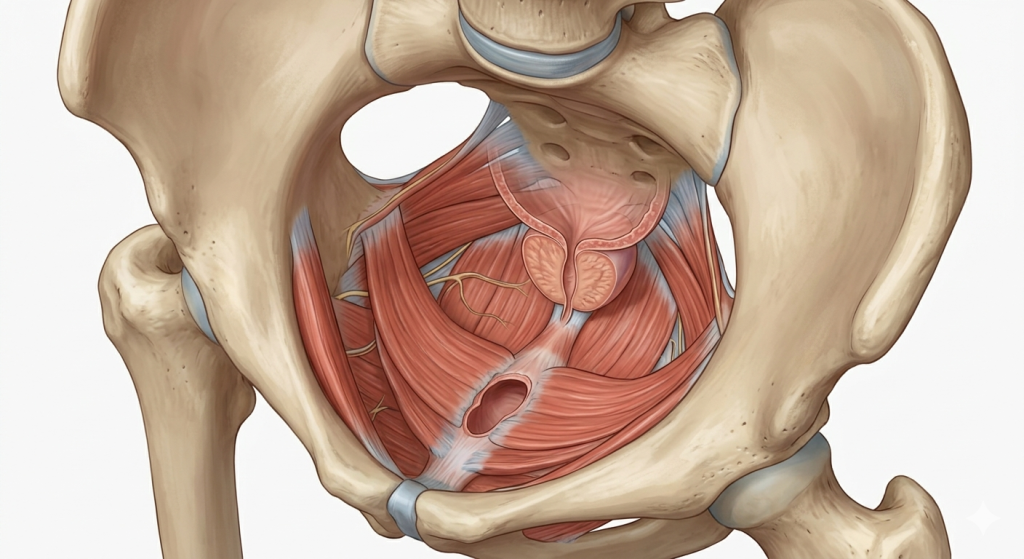
The pelvic floor is a “hammock” of muscles that stretches from the pubic bone at the front to the coccyx (tailbone) at the back. In men, these muscles support the bladder and the rectum. Learn more
Pelvic floor of human male.
Crucially, the urethra (the tube through which urine and semen pass) goes directly through these muscles. When these muscles are strong and coordinated, they provide the “stop-and-go” control for both waste and sexual performance.
2. Why It Matters: The Three Pillars of Function
For men, a healthy pelvic floor governs three primary areas of life:
I. Urinary and Bowel Control
The pelvic floor muscles wrap around the passages that lead out of the body. If these muscles are weak or overactive, it can lead to:
- Post-void dribbling: That annoying leak immediately after you think you’ve finished urinating.
- Urgency: The sudden, uncontrollable need to find a bathroom.
- Stress Incontinence: Leaking when coughing, sneezing, or lifting heavy weights.
II. Sexual Performance and Health
The muscles of the pelvic floor specifically the bulbocavernosus are responsible for the rigidity of erections and the force of ejaculation.
- Erectile Quality: These muscles help trap blood in the penis to maintain an erection.
- Control: Research suggests that pelvic floor training can be as effective as medication for some men dealing with premature ejaculation.
III. Core Stability and Power
The pelvic floor is the “base” of your core. It works in tandem with the diaphragm and the deep abdominal muscles (the transverse abdominis). If the base is weak, your “bracing” power during heavy lifts or athletic movements is compromised, potentially leading to lower back pain.
3. The Two Ends of the Spectrum: Weak vs. Hypertonic
Most people assume the only problem is a “weak” pelvic floor. However, in men, the opposite is often true.
- The Weak Pelvic Floor (Hypotonic): Common after prostate surgery or prolonged sitting. It leads to leaking and poor support.
- The Overactive Pelvic Floor (Hypertonic): Often found in high-stress individuals or athletes who “over-brace” their core. These muscles are perpetually clenched and cannot relax. This can cause pelvic pain, painful ejaculation, and difficulty starting a urine stream.
4. How to Train: The Modern Male Protocol
Training the pelvic floor (often called “Kegels” for men) isn’t about doing hundreds of reps; it’s about precision.
Step 1: Find the Muscles
The easiest way to identify the muscles is to try to stop the flow of urine mid-stream (do this once just to learn, not as a habit) or to imagine you are trying to lift your scrotum toward your belly button.
Step 2: The “Lift and Hold” (Strength)
- Exhale and slowly lift the pelvic floor muscles.
- Hold for 3–5 seconds while continuing to breathe (do not hold your breath).
- Slowly release and relax for 5 seconds.
- Repeat 10 times, twice a day.
Step 3: The “Quick Flick” (Power)
Contract and release the muscles as quickly as possible 10 times in a row. This trains the “fast-twitch” fibers needed to prevent leaks during a sudden sneeze or heavy lift.
5. Daily Habits for Pelvic Health
Beyond exercises, your lifestyle choices dictate the health of these muscles:
- Watch the Caffeine and Alcohol: Both are bladder irritants that can cause the pelvic floor to work overtime to manage urgency.
- Manage Your Weight: Excess visceral fat puts constant downward pressure on the pelvic hammock.
- Stop “Just in Case” Peeing: Training your bladder to go when it isn’t full can actually weaken the coordination of the pelvic floor over time.
- Fiber and Hydration: Chronic straining during bowel movements is one of the leading causes of pelvic floor dysfunction in men.
Read: The Impact of Digital Strain on Physical Posture
Conclusion: A Proactive Approach
Pelvic floor health is not a “women’s issue” it is a human performance issue. Whether you are an athlete looking for better core stability, a man in his 50s preparing for prostate health changes, or simply someone interested in functional longevity, the pelvic floor deserves a place in your wellness routine.