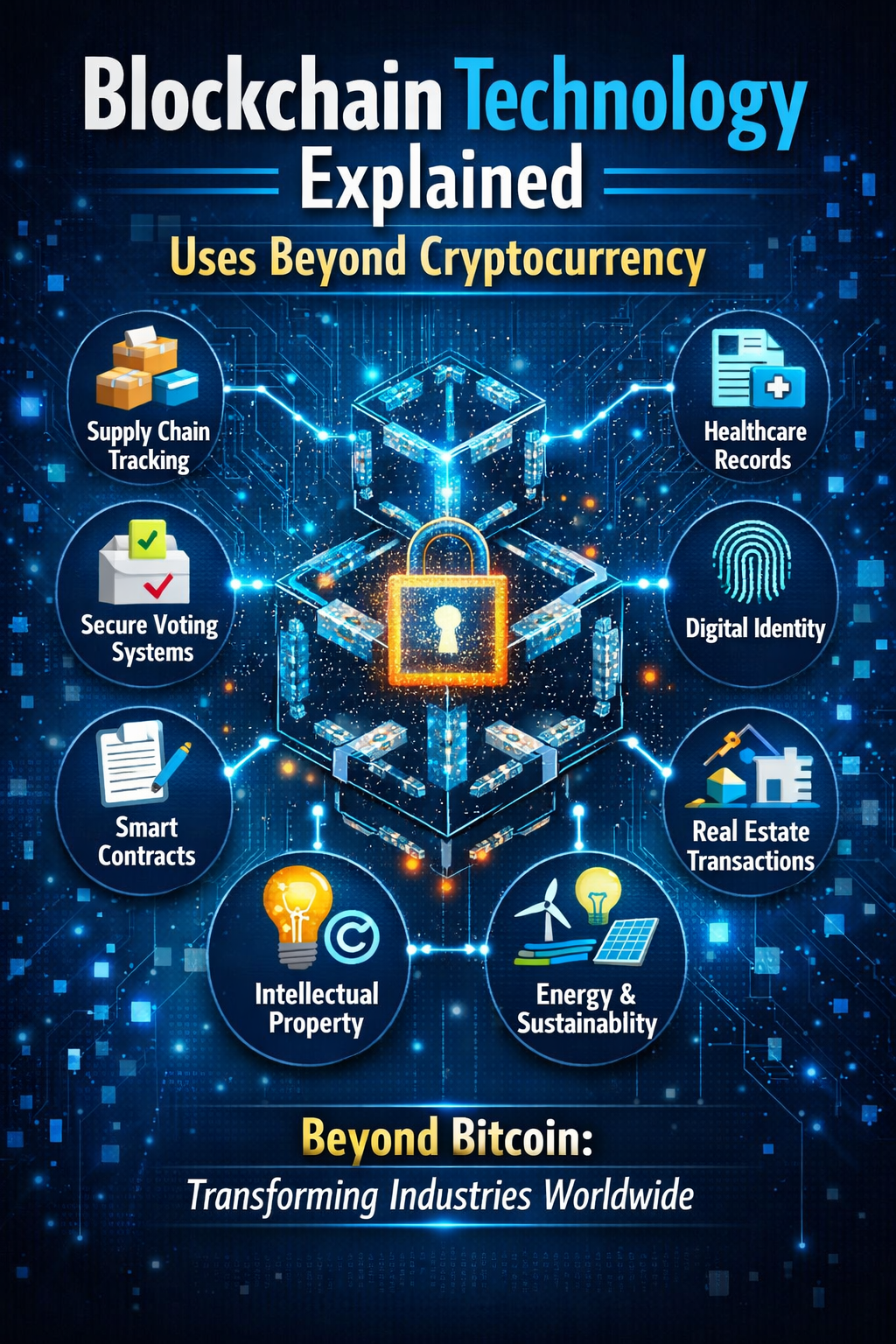
Blockchain Technology Explained: Uses Beyond Cryptocurrency
Introduction
Blockchain technology is often associated with cryptocurrencies like Bitcoin, but its potential goes far beyond digital money. Over the past decade, blockchain has evolved into a revolutionary technology capable of transforming multiple industries, from finance and healthcare to supply chain management and voting systems.
At its core, blockchain is a decentralized, secure, and transparent system for recording transactions. This unique combination of features makes it highly valuable in today’s data-driven world, where trust, security, and efficiency are critical.
In this article, we will explore blockchain technology explained in simple terms and examine its powerful uses beyond cryptocurrency.
What Is Blockchain Technology?
Blockchain is a type of distributed ledger technology (DLT) that records transactions across multiple computers in a way that ensures data cannot be altered once recorded.
Each “block” contains:
- Transaction data
- A timestamp
- A cryptographic hash of the previous block
These blocks are linked together to form a “chain,” making the system highly secure and resistant to tampering.
Unlike traditional databases controlled by a central authority, blockchain operates on a decentralized network, increasing transparency and trust among users. Learn more
Key Features of Blockchain Technology
Understanding blockchain becomes easier when you look at its core features:
1. Decentralization
No single entity controls the network, reducing the risk of manipulation.
2. Transparency
All transactions are visible to participants, enhancing trust.
3. Security
Advanced cryptography protects data from unauthorized access.
4. Immutability
Once data is recorded, it cannot be changed or deleted.
5. Efficiency
Transactions can be processed faster without intermediaries.
These features make blockchain suitable for many real-world applications beyond cryptocurrencies.
Uses of Blockchain Beyond Cryptocurrency
Blockchain technology is transforming industries in ways that were previously unimaginable. Here are some of its most impactful applications:
1. Supply Chain Management
Blockchain improves transparency and traceability in supply chains.
For example, companies can track products from production to delivery, ensuring authenticity and reducing fraud. This is especially useful in industries like food, pharmaceuticals, and luxury goods.
Benefits:
- Real-time tracking
- Reduced counterfeiting
- Improved efficiency
2. Healthcare
In healthcare, blockchain can securely store and share patient records.
Hospitals and clinics can access accurate medical histories without compromising patient privacy.
Use cases:
- Electronic health records
- Drug traceability
- Clinical trials data management
This enhances patient care and reduces administrative errors.
3. Financial Services
Beyond cryptocurrencies, blockchain is revolutionizing traditional finance.
Banks and financial institutions use blockchain for:
- Faster cross-border payments
- Fraud detection
- Smart contracts
Smart contracts are self-executing agreements with terms written into code, reducing the need for intermediaries.
4. Voting Systems
Blockchain can make voting more secure and transparent.
By using blockchain-based voting systems, governments can:
- Prevent voter fraud
- Ensure accurate vote counting
- Increase public trust
This could significantly improve democratic processes worldwide.
5. Digital Identity Verification
Blockchain provides a secure way to manage digital identities.
Instead of relying on centralized databases, individuals can control their personal information and share it securely when needed.
Applications:
- Online authentication
- Identity protection
- Secure login systems
6. Real Estate
Blockchain simplifies property transactions by reducing paperwork and eliminating intermediaries.
Benefits:
- Faster transactions
- Lower costs
- Transparent ownership records
Smart contracts can automate buying and selling processes, making real estate more efficient.
7. Intellectual Property Protection
Creators can use blockchain to protect their work and prove ownership.
This is particularly useful for:
- Artists
- Musicians
- Writers
Blockchain ensures that original content is securely recorded and cannot be copied without permission.
8. Energy Sector
Blockchain is being used to improve energy distribution and consumption.
Examples:
- Peer-to-peer energy trading
- Renewable energy tracking
- Smart grids
This helps promote sustainability and efficient energy use.
9. Education
Blockchain can store academic records securely.
Students can share verified credentials with employers without the risk of fraud.
Use cases:
- Digital certificates
- Academic transcripts
- Skill verification
10. Gaming Industry
Blockchain is transforming gaming by enabling true ownership of digital assets.
Players can:
- Buy, sell, and trade in-game items
- Earn rewards through gameplay
- Use cryptocurrencies within games
This creates new opportunities for gamers and developers.
Advantages of Blockchain Technology
Blockchain offers several benefits that make it a powerful innovation:
- Enhanced security
- Increased transparency
- Reduced costs
- Faster transactions
- Improved trust
These advantages are driving its adoption across industries.
Challenges of Blockchain Technology
Despite its potential, blockchain faces some challenges:
1. Scalability Issues
Handling large volumes of transactions can be difficult.
2. Energy Consumption
Some blockchain networks require significant energy.
3. Regulatory Uncertainty
Governments are still developing policies around blockchain.
4. Complexity
Understanding and implementing blockchain can be challenging.
The Future of Blockchain Technology
The future of blockchain looks promising as more industries adopt this technology.
Innovations such as:
- Decentralized finance (DeFi)
- Non-fungible tokens (NFTs)
- Enterprise blockchain solutions
are expanding its use cases even further.
Companies like IBM and Microsoft are investing heavily in blockchain research and development, indicating strong future growth.
Read:The Future of Remote Work: Tools and Technologies You Need
Conclusion
Blockchain technology is much more than just the foundation of cryptocurrencies like Bitcoin. Its ability to provide secure, transparent, and decentralized solutions makes it a game-changer across multiple industries.
From healthcare and finance to education and energy, blockchain is redefining how data is stored, shared, and protected. As technology continues to evolve, its impact will only grow stronger.
Understanding blockchain today is essential for staying ahead in tomorrow’s digital world.