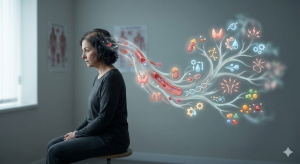
Perimenopause Symptoms Nobody Warns You About

Women’s Health | 7 min read
Most women know the word menopause. Far fewer know perimenopause the transitional phase that can begin as early as your mid-thirties and last anywhere from two to twelve years before your periods actually stop. It is during this window that the most disruptive symptoms occur, yet it remains one of the most underdiagnosed and underdiscussed phases in women’s health.
The conversation around perimenopause has historically been reduced to two things: hot flashes and irregular periods. If your doctor mentions it at all, that is usually the extent of it. But for millions of women, perimenopause shows up in far more unexpected, confusing, and distressing ways symptoms that get misdiagnosed as anxiety disorders, depression, chronic fatigue, or simply the pressures of a busy life.
This is the conversation nobody is having. Until now.
What Is Perimenopause, Exactly?
Perimenopause is the hormonal transition that precedes menopause — defined as twelve consecutive months without a period. During perimenopause, oestrogen and progesterone levels fluctuate erratically rather than declining steadily. It is this volatility, not just the eventual drop, that drives the wide range of symptoms women experience. Learn more
The average age of onset is the mid-to-late forties, but it is not uncommon for symptoms to begin in the late thirties. Because most women are not expecting hormonal shifts until their fifties, the symptoms that arrive earlier are frequently attributed to everything except what they actually are.
The Symptoms Nobody Tells You About
Anxiety That Comes Out of Nowhere
This is perhaps the most underrecognised perimenopausal symptom, and one of the most distressing. Women who have never experienced anxiety in their lives suddenly find themselves waking at 3am with racing thoughts, feeling inexplicably on edge, or experiencing a sense of dread with no identifiable cause.
The connection is biological. Oestrogen plays a direct role in regulating serotonin and GABA the neurotransmitters responsible for calm and emotional stability. When oestrogen fluctuates unpredictably, so does your brain chemistry. The result can feel indistinguishable from an anxiety disorder, and many women are prescribed antidepressants or anti-anxiety medication when the root cause is hormonal.
If you have developed anxiety in your late thirties or forties with no obvious life trigger, perimenopause deserves serious consideration.
Brain Fog and Memory Lapses
Forgetting words mid-sentence. Walking into a room and having no idea why. Reading the same paragraph three times and retaining nothing. Cognitive changes during perimenopause are real, common, and deeply unsettling particularly for high-functioning women who have never experienced them before.
Oestrogen supports neurological function in multiple ways. It promotes blood flow to the brain, supports the production of acetylcholine a neurotransmitter critical for memory and learning and has anti-inflammatory effects on brain tissue. When oestrogen levels become erratic, cognitive performance suffers accordingly.
The reassuring news is that research consistently shows perimenopausal brain fog is temporary. Cognitive function typically stabilises once hormonal fluctuations settle post-menopause. But knowing that does little to help the woman sitting in a meeting, struggling to recall a word she has used a thousand times.
Heart Palpitations
A sudden awareness of your heartbeat a flutter, a thud, a sensation that your heart has skipped or raced without warning is a perimenopausal symptom that sends many women straight to cardiology. In the absence of an underlying cardiac condition, these palpitations are frequently hormonal in origin.
Oestrogen has a protective effect on the cardiovascular system, including the regulation of heart rhythm. As levels fluctuate, some women experience noticeable changes in how their heart feels particularly at night, around hot flashes, or during periods of hormonal dip. While cardiac causes must always be ruled out, women who receive a clean bill of heart health and still experience palpitations should ask about hormonal investigation.
Joint Pain and Body Aches
Waking up stiff. Knees that ache on the stairs. Shoulders that didn’t hurt last year. Joint pain is one of the most commonly reported yet least attributed perimenopausal symptoms. Oestrogen has significant anti-inflammatory properties, and its fluctuation can trigger widespread musculoskeletal discomfort that mirrors conditions like early arthritis or fibromyalgia.
This symptom is particularly easy to misattribute to age, to overexertion, to a bad mattress when the underlying cause is hormonal. Women in their forties presenting with unexplained joint pain are rarely asked about their menstrual cycle or hormonal status, yet the connection is well established in research.
Rage, Irritability, and Emotional Volatility
Not sadness. Not just low mood. Rage. A disproportionate, sometimes frightening emotional intensity that feels out of character and out of control. Many women describe this as one of the most distressing and isolating aspects of perimenopause both because of its impact on relationships and because of the shame it carries.
Progesterone, which declines earlier and more sharply than oestrogen in perimenopause, has a calming, sedative effect on the nervous system. When progesterone drops, the nervous system becomes hypersensitive to stress. Small frustrations feel enormous. Patience disappears. This is not a personality change, it is a neurochemical one.
Skin and Hair Changes
Oestrogen is deeply involved in collagen production and skin hydration. As levels fluctuate, many women notice their skin becoming drier, thinner, or more prone to breakouts often simultaneously, which is particularly confusing. Some experience adult acne for the first time in decades, driven by the relative increase in androgens as oestrogen declines.
Hair thinning is also common and frequently overlooked as a perimenopausal symptom. As explored in our previous post on hair loss, low oestrogen and fluctuating androgens directly affect the hair growth cycle, and many women in perimenopause experience noticeable changes in hair density and texture.
Disrupted Sleep Beyond Night Sweats
Night sweats are well known. What is less discussed is the sleep disruption that occurs entirely independently of temperature the inability to fall asleep, the waking in the early hours, the light and unrestorative sleep that leaves women exhausted despite being in bed for eight hours.
Progesterone has natural sleep-promoting properties. Its decline in perimenopause directly compromises sleep architecture, reducing time spent in deep, restorative sleep stages. Combined with the anxiety and evening cortisol spikes that many perimenopausal women experience, sleep becomes a serious and compounding problem with downstream effects on mood, cognition, metabolism, and immunity.
Changes in Libido and Sexual Health
A drop in sexual desire during perimenopause is common and has both hormonal and psychological drivers. Declining oestrogen and testosterone reduce libido directly, while vaginal dryness caused by thinning vaginal tissue can make sex uncomfortable or painful, creating an additional layer of avoidance.
These changes are rarely raised proactively in clinical settings, and many women suffer in silence, assuming this is simply an inevitable part of ageing. It is not. Effective interventions exist from localised oestrogen to pelvic floor therapy to systemic hormone replacement but they require the conversation to be had first.
Read: What Your Hair Loss Is Really Trying to Tell You
What You Can Do
The first step is recognition. Many women spend years being treated for anxiety, depression, insomnia, or autoimmune conditions when the underlying driver is perimenopausal hormonal fluctuation. If you are a woman in your late thirties or forties experiencing a cluster of the symptoms described above particularly alongside changes in your menstrual cycle perimenopause should be part of the conversation with your doctor.
Ask for a hormonal assessment including FSH, LH, oestradiol, progesterone, and testosterone. Be aware that a single normal result does not rule out perimenopause, since hormone levels fluctuate significantly during this phase. Symptoms, timing, and clinical picture matter as much as lab values.
Hormone replacement therapy has been significantly rehabilitated by recent research, with updated guidance from most major medical bodies now supporting its use for appropriate candidates. Lifestyle interventions strength training, reduced alcohol, blood sugar stability, and stress management also have meaningful impact on symptom severity.
Most importantly, advocate for yourself. Perimenopause is not a niche women’s issue. It affects every woman who lives long enough, for a significant portion of her most productive years. The symptoms are real, the science is clear, and the support available is far better than most women are told.