What Eating Grapes Daily Does to Your Skin at the Genetic Level
Health & Wellness | 10 min read
Most people reach for a bunch of grapes as a quick snack without giving it much thought. It is convenient, sweet, and satisfying. But new research published in May 2026 suggests that this ordinary fruit may be doing something far more remarkable inside your body than anyone previously understood. Scientists have now found evidence that eating grapes every day quietly changes how your skin behaves, not on the surface, but at the genetic level where real biological decisions are made.
This is not a marketing claim on a beauty product. It comes from a peer-reviewed study published in ACS Nutrition Science by researchers at Western New England University working alongside scientists at Oregon State University. And the findings are turning heads in the nutrition and dermatology world.
Understanding the Research
The study was conducted with human volunteers, not animals and not cells in a laboratory dish. Participants consumed the equivalent of three servings of whole grapes every single day for two weeks. Before the study began, scientists collected skin samples from each volunteer to establish a genetic baseline. After the two-week period of daily grape consumption, they collected samples again and analysed which genes had become more active and which had quietened down.
They also went one step further. To understand how grapes affected the skin’s ability to handle environmental stress, they exposed participants’ skin to controlled low doses of ultraviolet radiation, the same type of radiation your skin encounters on a sunny day. Then they compared the gene activity in skin that had been exposed to UV with skin that had not, both before and after the grape consumption period.
What they found gave the scientific community a reason to look at this humble fruit in a completely new way.
Your Genes Are Responding to What You Eat
The most important finding from this research is that grape consumption changed gene expression in the skin of every single participant. Not most of them. Not a particular group with a certain genetic profile. Every person in the study showed measurable shifts in skin gene activity after eating grapes daily for two weeks.
To appreciate why this matters, it helps to understand what gene expression actually means. Your DNA contains billions of instructions for how your body should function. But not all of those instructions are being followed at the same time. Gene expression is essentially the process by which your body decides which instructions to read and act on, and which ones to leave on the shelf. Certain foods, environmental conditions, stress, and lifestyle habits can all influence this process, turning certain genes on or off in response to what is happening around and inside you.
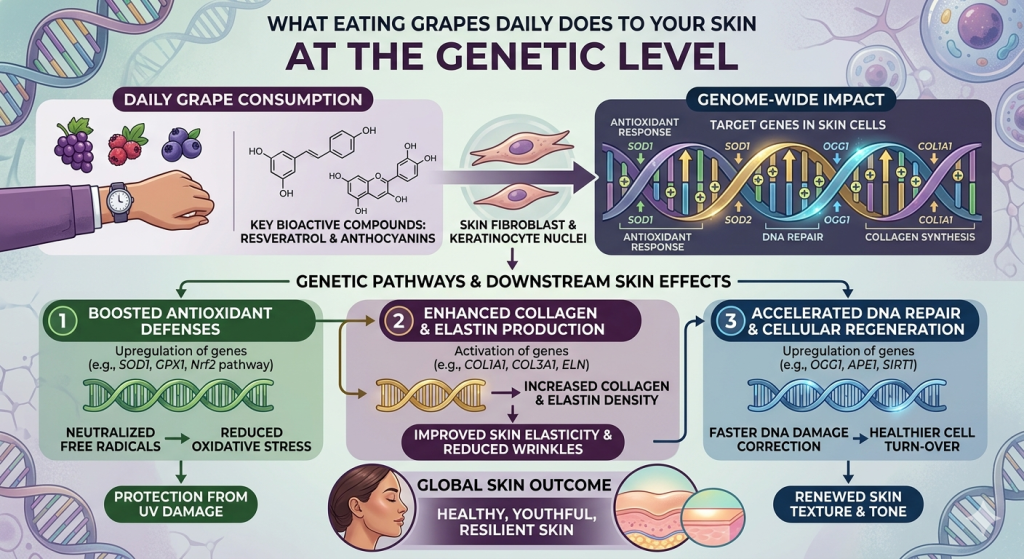
Grapes did not rewrite anyone’s DNA. What they did was influence which genes were being actively read and used by the skin. Specifically, consumption led to increased activity in genes related to keratinisation and cornification. These are biological processes responsible for forming and maintaining the outermost protective layer of the skin. When these genes are functioning well, the skin barrier is stronger, more resilient, and better equipped to handle damage from outside sources like pollution, bacteria, and ultraviolet radiation.
In simpler terms, eating grapes for two weeks told the skin to toughen up and protect itself more effectively, and the skin listened. Learn more
The UV Protection Finding
One of the most practically useful aspects of this research relates to how the skin handles sun exposure. Previous clinical trials had already established that eating grapes could increase the skin’s resistance to UV radiation in somewhere between thirty and fifty percent of people. That was already a noteworthy finding. But researchers suspected the actual impact was broader than those earlier numbers suggested.
This new study confirmed that suspicion. When gene expression was analysed in detail, the protective genetic changes were found in all participants, not just the thirty to fifty percent who showed measurable UV resistance in earlier work. The earlier trials were looking at a narrower set of outcomes, essentially whether or not someone got sunburned more easily. The new research looked deeper, at the underlying genetic activity that precedes those visible outcomes, and found that something was happening in everyone.
The study also found reduced levels of malondialdehyde in the skin of participants after UV exposure during the grape consumption period. Malondialdehyde is a well-established biomarker of oxidative stress, which is the kind of cellular damage that accumulates when the skin is hit by UV radiation. Lower levels of this compound after sun exposure indicate that the skin was handling the radiation more effectively and producing less internal damage as a result.
What Is Actually in Grapes That Does This
Grapes are not a single compound. They are a dense package of biologically active substances that work together in ways scientists are still working to fully understand. The main players appear to be polyphenols, a broad category of plant compounds known for their antioxidant and anti-inflammatory properties.
Resveratrol is perhaps the most well-known of these. It is concentrated primarily in the skin of red and black grapes and has been studied for its potential to protect cells against oxidative damage and slow certain ageing processes. Prior research involving resveratrol found documented protective effects against skin damage, and earlier studies on regular grape juice consumption found that it reduced oxidative DNA damage and lowered free radical levels in the blood of healthy adults.
Beyond resveratrol, grapes also contain flavonoids including quercetin and kaempferol, as well as anthocyanins, which are the pigments responsible for the deep red and purple colour of darker grape varieties. These compounds have independently shown anti-inflammatory effects in other research contexts. Together, when consumed regularly in whole grape form, they appear to reach the skin through the bloodstream and interact with gene activity in a way that prompts protective responses.
The field of science that studies this relationship between food compounds and gene activity is called nutrigenomics. This grape study is one of the clearest human examples yet of nutrigenomics in action, where an ordinary food is shown to influence gene expression in a specific tissue in a consistent and measurable way.
The Response Was Personal but Universal
One of the more nuanced and genuinely interesting aspects of the research was the degree of individual variation observed. While every participant showed genetic changes in their skin after eating grapes, the specific pattern of those changes differed from person to person. Two volunteers eating the same amount of grapes for the same two weeks ended up with different gene expression profiles.
This reflects the broader reality of human biology. No two people have exactly the same starting point in terms of their genetic makeup, their existing microbiome, their skin condition, their diet history, or their UV exposure habits. So it makes sense that even a consistent intervention like daily grape consumption would produce results that share common themes but differ in their specifics.
What this means practically is that the protective effect of grapes appears to be universal in the sense that something beneficial happens in everyone, but the nature and extent of that benefit will vary. For some people the gain may be more pronounced. For others it may be subtler. But the direction of change appears to be consistent across the board, and that is an encouraging finding.
Beyond the Skin
Researchers were careful to note that the implications of these findings likely do not stop at the surface of the skin. The compounds in grapes travel through the bloodstream after digestion, meaning they have the potential to interact with gene expression in other tissues and organs throughout the body.
This is supported by a broader body of existing research. Studies have linked regular grape consumption to improvements in cardiovascular health, including better blood vessel function and lower markers of inflammation. Other research has found benefits for gut health through effects on the microbiome, and separate work has associated regular grape intake with better cognitive performance in older adults, including sharper memory and processing speed.
The current study was focused on skin, but the researchers believe it is part of a larger picture of how grapes influence human biology at a fundamental level. Professor John Pezzuto of Western New England University, who led the research, stated that the findings confirm grapes act as a superfood that mediates a nutrigenomic response in humans. That is a significant claim from a credible source, and it positions grapes among a relatively small number of foods for which there is solid human evidence of gene-level effects.
Knowing the Limits of the Research
Good science requires honesty about what a study can and cannot tell us, and this research is no exception. The trial was conducted over two weeks, which is long enough to observe gene activity changes but not long enough to tell us whether those changes grow stronger over months, plateau after a certain point, or gradually fade if grape consumption stops.
The study also measured biological markers rather than visible real-world outcomes. Knowing that malondialdehyde levels dropped after UV exposure is meaningful, but it does not directly translate to knowing how this affects a person’s risk of sunburn, premature skin ageing, or skin cancer over decades. Those connections are plausible given the biology, but they require longer-term studies to confirm.
Participants were healthy adults, so it is not yet clear whether people with specific skin conditions, darker or lighter skin tones, very different ages, or high cumulative UV exposure from years of sun damage would respond in the same way.
Grapes are also not a replacement for sunscreen. The researchers were explicit about this. They are what you might call a complementary strategy, something that may reinforce your skin’s natural defences from the inside while conventional sun protection handles the outside. The two approaches work through entirely different mechanisms and there is no reason to treat them as competing options.
How to Make the Most of This
The participants in the study ate the equivalent of three servings of whole grapes per day, spread across the two-week period. A serving of grapes is roughly a generous handful, around eighty grams. So three servings would be something close to a full cup or slightly more eaten throughout the day.
The research used whole grapes, not grape juice, not supplements, and not grape seed extract. It is worth paying attention to that detail. Processing changes the composition of food. Juice typically has lower fibre content and higher sugar concentration per serving. Supplements may isolate certain compounds while missing others that contribute to the overall effect. The safest interpretation of this research is that whole grapes are what was studied and whole grapes are what showed the results.
In terms of variety, red and black grapes tend to carry higher concentrations of resveratrol and anthocyanins due to their darker pigment, though all varieties contributed positively in the research. If you have a preference for green grapes, there is no reason to abandon them, but rotating between varieties or leaning toward the darker ones is a reasonable approach if you want to maximise polyphenol intake.
Eating them as part of a meal rather than as an isolated snack may also be beneficial, since consuming polyphenols alongside fats and proteins can influence how they are absorbed and distributed in the body.
Read: The Benefits of Decluttering Your Home and Mental Space
The Bottom Line
A daily portion of grapes is one of the most effortless additions you can make to your diet. The research is still developing and the long-term picture is not yet complete. But what this study demonstrates clearly is that something as ordinary as three handfuls of grapes a day is capable of switching on protective genes in your skin, reducing oxidative damage caused by sun exposure, and potentially communicating benefits to tissues throughout your body, all within two weeks.
Your skin is not just a passive barrier. It is a living, responsive organ that pays close attention to what you feed it. And it turns out that grapes have quite a lot of good things to say.