The “K-Shaped” Recovery: Why Some Prosper While Others Struggle

In the wake of major economic disruptions, we often look for “V-shaped” or “U-shaped” recoveries to signal a return to normalcy. However, the K-shaped recovery describes a more complex and troubling phenomenon: an economy that bifurcates, where different sectors and population groups recover at vastly different speeds, or in entirely different directions.
What is a K-Shaped Recovery?
A K-shaped recovery occurs when the path of the economy splits into two separate “arms.”
- The Upward Arm: Represents industries and individuals that recover quickly and even thrive (e.g., technology, finance, and high-income professionals).
- The Downward Arm: Represents sectors and workers that continue to struggle, experience long-term stagnation, or face permanent decline (e.g., hospitality, retail, and low-wage service workers). Learn more
Why the Split Occurs: The Key Drivers
The divergence isn’t random; it is driven by structural factors that dictate who can adapt to a changing economic landscape.
1. The Digital Divide
Wealth and recovery are increasingly tied to “knowledge work.” Workers who can perform their jobs remotely and industries that facilitate digital commerce (like software and e-commerce) occupy the upward arm. Conversely, “high-touch” industries that require physical presence like travel and dining often find themselves on the downward arm during crises.
2. Asset Ownership vs. Labor Income
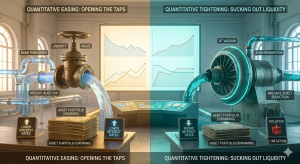
A K-shaped recovery is often exacerbated by monetary policy. When central banks inject liquidity to stabilize the economy, it often inflates the price of assets like stocks and real estate. Those who already own these assets see their net worth soar, while those who rely solely on hourly wages find their purchasing power eroded by rising costs.
3. Access to Capital
Large corporations typically have easier access to credit markets and government stimulus, allowing them to weather a storm and even acquire struggling competitors. Small businesses, however, often lack these financial safety nets, leading to a higher rate of closures and job losses in the “Downward” arm.
The Social and Economic Consequences
The danger of a K-shaped recovery is that it deepens existing inequalities.
- Widening Wealth Gap: The disparity between the top and bottom earners becomes a structural fixture rather than a temporary setback.
- Decreased Social Mobility: As the downward arm becomes more entrenched, it becomes harder for individuals to move into higher-growth sectors without significant retraining or education.
- Political Instability: When a large portion of the population feels left behind by a “recovering” economy, it often leads to social unrest and a push for radical policy shifts.
Read: Quantitative Easing vs. Tightening: How Central Banks Control Your Money
How to Bridge the Gap
Fixing a K-shaped recovery requires targeted intervention rather than “trickle-down” policies.
- Upskilling and Education: Providing pathways for workers in declining industries to transition into high-growth digital or green energy roles.
- Infrastructure for All: Ensuring that high-speed internet and digital tools are accessible to every household, not just those in wealthy enclaves.
- Small Business Support: Tailoring stimulus and tax incentives specifically for the “Downward” arm to prevent total market consolidation by a few large players.