The Foundation of Longevity: Why Posture is the Ultimate Investment in Spinal Health
In the modern digital landscape, our bodies are undergoing a silent structural shift. We spend hours hunched over laptops, scrolling through smartphones, and sitting in chairs that were never designed for the human frame. While we often treat posture as a matter of “sitting up straight” to look professional, it is actually the most critical factor in your long-term musculoskeletal health.
Your spine is much more than a stack of bones; it is the central pillar of your nervous system and the structural foundation for every movement you make. Neglecting it today doesn’t just lead to a stiff neck tomorrow, it sets the stage for chronic degeneration that can impact your quality of life for decades.
The Anatomy of Alignment: Understanding the “S-Curve”
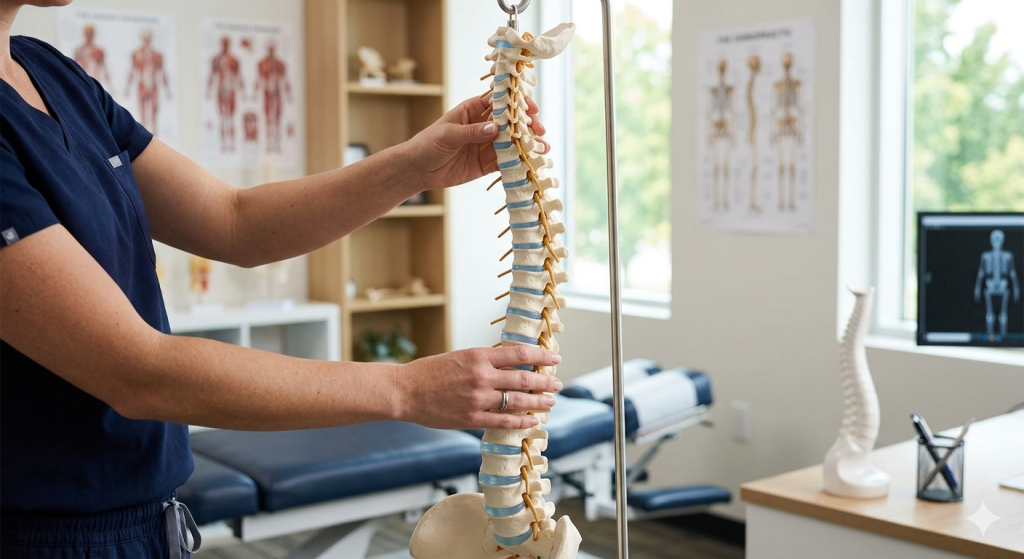
To understand why posture matters, we must first look at the anatomy of the spine. A healthy human spine has three natural curves: the cervical curve (neck), the thoracic curve (middle back), and the lumbar curve (lower back). Together, these form an “S” shape that acts as a sophisticated shock-absorption system.
When you maintain “neutral alignment,” your weight is distributed evenly across your vertebrae and the intervertebral discs that sit between them. In this state, your muscles, ligaments, and tendons are under the least amount of strain. However, when you slouch or lean forward a position now commonly referred to as “Tech Neck” the physics of your body changes. For every inch your head moves forward from its neutral position, it gains roughly 10 pounds of “effective weight” on the muscles of the neck and upper back. Learn more
The Cascading Effects of Poor Posture
Poor posture is rarely a localized problem. It creates a “domino effect” that impacts the entire body:
- Disc Degeneration and Herniation: Chronic misalignment puts uneven pressure on spinal discs. Over time, this causes the discs to compress and wear down (Degenerative Disc Disease) or even bulge and rupture (Herniated Discs), which can lead to debilitating nerve pain.
- Muscle Imbalance and “Crossed Syndromes”: When you slouch, certain muscles (like your chest and hip flexors) become chronically tight and shortened, while others (like your upper back and glutes) become overstretched and weak. This creates a cycle where your body “forgets” how to hold itself upright, making good posture feel exhausting.
- Restricted Breathing and Circulation: Slumping forward compresses the thoracic cavity. This prevents the diaphragm from expanding fully, leading to shallow breathing and reduced oxygen levels in the blood, which contributes to fatigue and brain fog.
- Digestive Issues: Believe it or not, your gut health is tied to your back. Compressing the abdominal organs through poor sitting habits can slow down the movement of food through the digestive tract, contributing to acid reflux and constipation.
The Professional Guide to Ergonomic Health
Fixing your posture isn’t about willpower; it’s about environment and habit. If you work at a desk, your setup is your primary defense against spinal decay.
- The Eye-Level Rule: Your monitor should be positioned so that the top third of the screen is at eye level. This ensures your chin remains neutral rather than tucked or extended.
- The 90-90-90 Rule: Ensure your elbows are at a 90-degree angle to your keyboard, your hips are at 90 degrees in your chair, and your knees are at 90 degrees with your feet flat on the floor.
- Active Sitting: Invest in a chair with dedicated lumbar support that follows the natural curve of your lower back. If you don’t have one, place a small lumbar roll or a folded towel behind your lower back to maintain that inward curve.
Corrective Strategies for Spinal Longevity
You cannot undo eight hours of sitting with five minutes of stretching, but consistent “micro-habits” can rewire your body:
- The 20-8-2 Rule: For every 30 minutes of work, sit for 20 minutes, stand for 8 minutes, and spend 2 minutes moving or stretching. Movement is the “oil” for your spinal joints.
- Chin Tucks: While sitting, gently draw your head straight back (creating a “double chin”) without tilting your head up or down. This strengthens the deep neck flexors that support your cervical spine.
- Wall Slides: Stand with your back against a wall and try to keep your arms in a “cactus” position while sliding them up and down. This is the ultimate “reset” for rounded shoulders.
Read: How Chronic Stress Impacts Your Immune System
The Bottom Line
Spinal health is a marathon, not a sprint. The choices you make today the way you sit while reading this, the height of your monitor, and the frequency of your movement will determine your mobility 20 years from now. By prioritizing alignment and ergonomics, you aren’t just avoiding back pain; you are ensuring that your body remains a capable vessel for everything life has to offer.